
Introduction
Projective techniques occupy a unique and enduring place in the field of clinical and abnormal psychology. Emerging from psychoanalytic traditions, these methods are based on the assumption that individuals project their unconscious motives, emotions, and conflicts onto ambiguous stimuli (Sarason & Sarason, 2005). By interpreting such projections, clinicians gain insight into personality dynamics that are often inaccessible through structured inventories or direct questioning.
Two of the most significant projective techniques—the Rorschach Inkblot Test and the Thematic Apperception Test (TAT)—have profoundly influenced personality assessment, clinical diagnosis, and psychodynamic understanding (Carson, Butcher, Mineka, & Hooley, 2007; Barlow & Durand, 1999).
Read More: Projective Tests
Theoretical Foundations of Projective Assessment
Projective techniques are grounded in psychoanalytic theory, particularly the works of Freud and Jung. The central assumption is that ambiguous stimuli elicit responses that reflect internal conflicts, wishes, and personality structures (Rychlak, 1973).
According to projection theory, individuals externalize elements of their unconscious—defenses, impulses, and desires—onto neutral objects. In clinical assessment, such responses can illuminate latent content, ego strength, and personality organization (Wolman, 1975).
Contemporary psychology also recognizes projective tests as valuable qualitative tools for exploring thought processes, affect regulation, and interpersonal perception (Sundberg, Winebarger, & Taplin, 2002).
Rorschach Inkblot Test
The Rorschach Inkblot Test was developed by Hermann Rorschach in 1921 as part of his exploration of perceptual and associative processes in psychopathology. Initially designed for diagnosing schizophrenia, it evolved into a comprehensive tool for personality assessment (Carson et al., 2007).

Rorschach Cards
Rorschach’s method was later standardized and expanded through interpretive systems, most notably Exner’s Comprehensive System, which integrated scoring variables to enhance reliability (Butcher, Mineka, & Hooley, 2014).
Structure and Materials
The test consists of 10 inkblot cards:
- Five black-and-white cards
- Two black, white, and red cards
- Three multicolored cards
Each blot is bilaterally symmetrical but lacks inherent meaning. The ambiguity encourages subjects to interpret the shapes, colors, and forms freely (Sarason & Sarason, 2005).
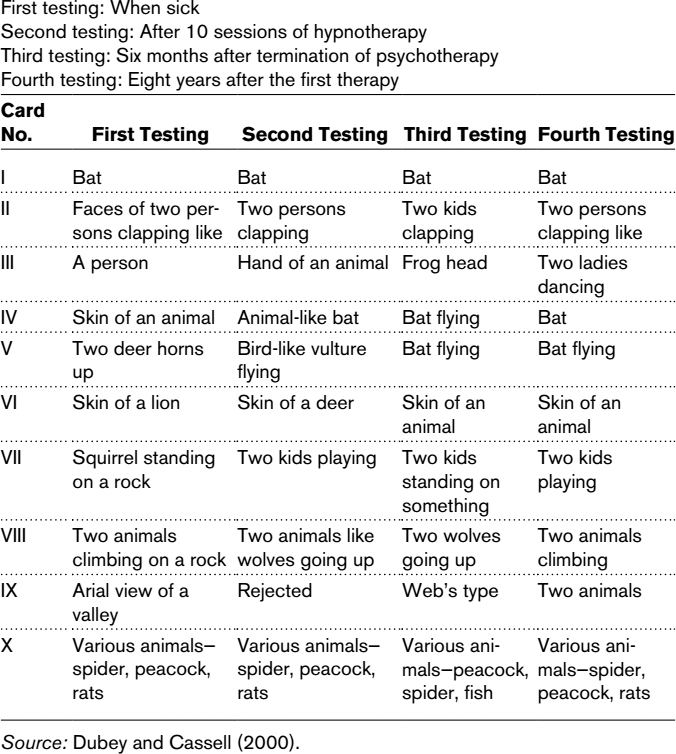
Sample Interpretation
Administration Procedure
The Rorschach is typically administered in two phases:
- Free Association Phase: The examiner presents each card sequentially and asks, “What might this be?” All responses are recorded verbatim.
- Inquiry Phase: The examiner revisits each card and asks the respondent to indicate where they saw what they described and what features led to the response.
The process generally takes 45–60 minutes. A rapport-based, non-directive style is essential for authentic projections to emerge (Wolman, 1975).
Scoring and Interpretation
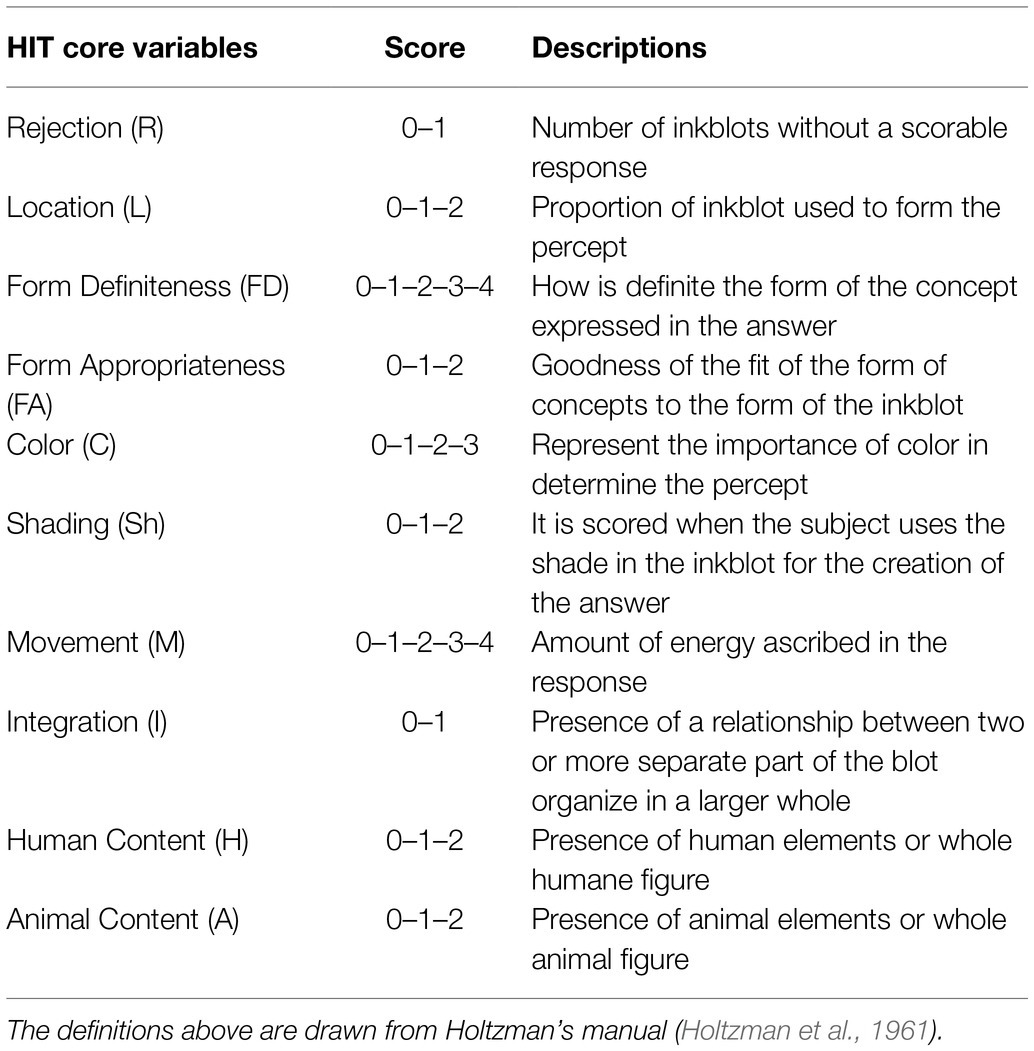
Under Exner’s Comprehensive System, responses are coded on several parameters:
- Location (W, D, Dd): Whole blot, common detail, or unusual detail
- Determinants: Form, color, shading, movement
- Content: Human, animal, object, abstract forms
- Popularity: Frequency of common responses
- Form Quality: Accuracy and appropriateness of perception
Interpretation integrates these elements to infer aspects of:
- Cognitive processes: Organization, perceptual accuracy
- Affective regulation: Impulse control, emotional tone
- Interpersonal perception: Empathy, boundary maintenance
- Defensive functioning: Projection, denial, repression (Davison, Neal, & Kring, 2004)
Scoring Variables
Psychometric Evaluation
Despite criticism over subjectivity, modern Rorschach systems show satisfactory reliability (r ≈ 0.80) and validity, particularly in assessing thought disorder, affective instability, and personality pathology (Anastasi & Urbina, 2005).
Advantages:
- Access to unconscious material
- Resistance to deliberate faking
- Rich qualitative data
Limitations:
- Requires extensive training
- Time-consuming administration
- Cultural variability in responses (Kapur, 1995)
Nevertheless, the Rorschach remains one of the most widely researched projective techniques, used internationally in personality and forensic assessment.
Thematic Apperception Test (TAT)
Developed by Henry A. Murray and Christiana D. Morgan (1935) at Harvard University, the Thematic Apperception Test (TAT) explores interpersonal needs, drives, and conflicts through storytelling. It is grounded in Murray’s theory of needs and presses, where behavior reflects the dynamic interaction between internal motives (needs) and external pressures (presses) (Carson et al., 2007).

TAT Cards
Structure and Materials
The TAT consists of 31 picture cards, including:
- 10 cards for all respondents
- Specific sets for men, women, and children
Each card depicts ambiguous social situations involving people in various contexts. Respondents are asked to create a story describing:
- What is happening in the picture,
- What led up to it,
- What the characters are thinking and feeling, and
- How the story will end (Barlow & Durand, 1999).
Administration and Procedure
The test is administered individually in a quiet setting. Typically, 10–20 cards are used, depending on time and clinical focus. The subject is encouraged to construct spontaneous, imaginative narratives, while the examiner records them verbatim (Sarason & Sarason, 2005).
The process usually takes 50–75 minutes, and rapport maintenance is essential to facilitate openness and creativity.
Scoring and Interpretation
Interpretation focuses on recurrent themes, emotional tone, and need–press analysis:
- Needs (N): Internal drives (e.g., achievement, affiliation, power)
- Presses (P): Environmental factors influencing behavior
- Outcome: Success, failure, frustration, conflict resolution
Common interpretive frameworks include:
- Murray’s Need-Press System
- Bellak’s Scoring System (quantitative)
- Cramer’s Defense Mechanisms Manual
The TAT reveals:
- Dominant motivational patterns
- Self-image and interpersonal perception
- Coping mechanisms
- Unconscious conflicts and aspirations (Davison et al., 2004)
Psychometric Considerations
While early critiques targeted the TAT’s subjectivity, structured scoring systems have enhanced reliability and validity. It has strong content validity for exploring motivational dynamics and personality themes (Alloy, Riskind, & Manos, 2005).
Advantages:
- Rich qualitative insights into motives
- Useful for psychodynamic formulation
- Effective in psychotherapy and counseling settings
Limitations:
- Requires skilled interpretation
- Lacks standard norms for many populations
- Stories may reflect current mood rather than stable traits (Taylor, 2006)
Conclusion
The Rorschach Inkblot Test and Thematic Apperception Test remain invaluable tools for exploring the complexities of personality. While modern psychology emphasizes objective, psychometric instruments, projective techniques offer unmatched depth in uncovering unconscious dynamics and subjective meaning.
When used judiciously—within a multimodal assessment framework—they enrich clinical understanding, bridge the gap between behavior and experience, and affirm the centrality of human individuality in psychological science (Sarason & Sarason, 2005; Carson et al., 2007).
References
Alloy, L. B., Riskind, J. H., & Manos, M. J. (2005). Abnormal Psychology: Current Perspectives (9th ed.). Tata McGraw-Hill: New Delhi.
Anastasi, A., & Urbina, S. (2005). Psychological Testing (7th ed.). Pearson Education: India.
Barlow, D. H., & Durand, V. M. (1999). Abnormal Psychology (2nd ed.). Pacific Grove: Brooks/Cole.
Butcher, J. N., Mineka, S., & Hooley, J. M. (2014). Abnormal Psychology (15th ed.). Dorling Kindersley (India) Pvt. Ltd: Pearson Education.
Carson, R. C., Butcher, J. N., Mineka, S., & Hooley, J. M. (2007). Abnormal Psychology (13th ed.). Pearson Education India.
Davison, G. C., Neal, J. M., & Kring, A. M. (2004). Abnormal Psychology (9th ed.). New York: Wiley.
Kapur, M. (1995). Mental Health of Indian Children. Sage Publications: New Delhi.
Lezak, M. D. (1995). Neuropsychological Assessment. Oxford University Press: New York.
Rychlak, F. (1973). Introduction to Personality and Psychopathology. Houghton Mifflin: New York.
Sarason, I. G., & Sarason, B. R. (2005). Abnormal Psychology. Dorling Kindersley: New Delhi.
Sundberg, N. D., Winebarger, A. A., & Taplin, J. R. (2002). Clinical Psychology: Evolving Theory, Practice and Research. Prentice-Hall: Upper Saddle River, N.J.
Taylor, S. (2006). Health Psychology. Tata McGraw-Hill: New Delhi.
Wolman, B. B. (1975). Handbook of Clinical Psychology. New York: McGraw-Hill.
Niwlikar, B. A. (2025, October 17). 2 Important Projective Techniques: Rorschach Inkblot Test and Thematic Apperception Test (TAT). Careershodh. https://www.careershodh.com/rorschach-inkblot-test-and-thematic-apperception-test/