
Introduction
Assessing intellectual functioning is a cornerstone of clinical psychology, particularly in diagnosing and understanding intellectual disability (ID) and related developmental disorders. Intellectual disability involves significant limitations in both intellectual functioning (reasoning, learning, problem-solving) and adaptive behavior, originating before the age of 18 (Kaplan, Sadock, & Grebb, 1994). Reliable and valid assessment tools are essential for diagnosis, intervention planning, and educational placement.
Among the most widely recognized techniques for intellectual disability assessment are the Bhatia Battery of Performance Tests of Intelligence (BKT), the Wechsler Intelligence Scale for Children (WISC), and the Vineland Social Maturity Scale (VSMS). These tools, although different in scope and theoretical background, together provide a comprehensive understanding of cognitive and adaptive functioning in individuals with intellectual disabilities.
Read More: Intellectual Disability
The Concept of Intellectual Disability
Intellectual disability has evolved conceptually from being viewed as a fixed deficit to being understood as a condition with biopsychosocial determinants (Davison, Neal, & Kring, 2004). The American Association on Intellectual and Developmental Disabilities defines ID as impairments in intellectual functioning (IQ below 70–75) and deficits in adaptive behavior across conceptual, social, and practical domains.
As Sarason and Sarason (2005) note, psychological assessment of ID requires both quantitative intelligence testing and qualitative observation of adaptive skills. Therefore, clinicians rely on a combination of standardized intelligence tests (such as the WISC or BKT) and social maturity scales (such as the Vineland) to form a holistic understanding of the individual’s abilities.
1. Bhatia Battery of Performance Tests of Intelligence (BKT)
Developed by Dr. C.M. Bhatia in India during the 1940s, the Bhatia Battery of Performance Tests of Intelligence (BKT) was designed to measure intelligence among individuals from varied cultural and linguistic backgrounds. The test’s non-verbal format makes it particularly suitable for use in India’s multilingual context, where language-based intelligence tests may not provide accurate results (Kapur, 1995).

Bhatia Battery of Intelligence
The BKT is grounded in the performance-based tradition of intelligence assessment, emphasizing visual-motor coordination, problem-solving, and abstract reasoning over verbal comprehension. This makes it appropriate for individuals with speech or hearing impairments, and for those from non-English-speaking environments (Anastasi & Urbina, 2005).
Structure and Components
The BKT consists of five subtests, each designed to tap different cognitive abilities:
- Koh’s Block Design Test – Measures visual-spatial organization and problem-solving skills.
- Alexander’s Passalong Test – Assesses reasoning and the ability to learn from experience.
- Pattern Drawing Test – Evaluates perceptual-motor coordination and planning.
- Picture Construction Test – Involves reconstructing a complete picture from parts, testing analytical reasoning.
- Immediate Memory Test – Measures short-term memory and attention span.
The test is suitable for individuals aged 11–16 years and is especially used in clinical and educational settings for assessing children with suspected intellectual disabilities or learning difficulties (Kapur, 1995).
Administration and Scoring
The BKT is administered individually, typically taking 45–60 minutes. Performance on each subtest is scored according to standardized criteria, and the raw scores are converted into Mental Age (MA) and Intelligence Quotient (IQ).
Applications
The BKT is widely used in:
- Clinical diagnosis of intellectual disability and developmental delay.
- School assessments to identify children requiring special educational interventions.
- Neuropsychological evaluation, particularly in cases where verbal communication is limited (Lezak, 1995).
Because of its culture-fair, non-verbal design, the BKT remains an essential tool in Indian psychological assessment contexts (Kapur, 1995).
Strengths and Limitations
The BKT’s major strength lies in its cultural adaptability and non-verbal nature, which reduces linguistic bias (Sarason & Sarason, 2005). It is easy to administer and score, making it accessible for field and clinical use.
However, the test has limitations, including outdated norms and limited applicability beyond Indian populations. Moreover, since it measures mainly performance intelligence, it may underestimate the abilities of individuals with strong verbal reasoning but weak visual-motor coordination (Carson, Butcher, Mineka, & Hooley, 2007).
2. Wechsler Intelligence Scale for Children (WISC)
The Wechsler Intelligence Scale for Children (WISC), developed by David Wechsler in 1949, is one of the most extensively used instruments for assessing intelligence in children aged 6–16 years. The WISC is based on Wechsler’s definition of intelligence as “the aggregate or global capacity of the individual to act purposefully, think rationally, and deal effectively with the environment” (Anastasi & Urbina, 2005).
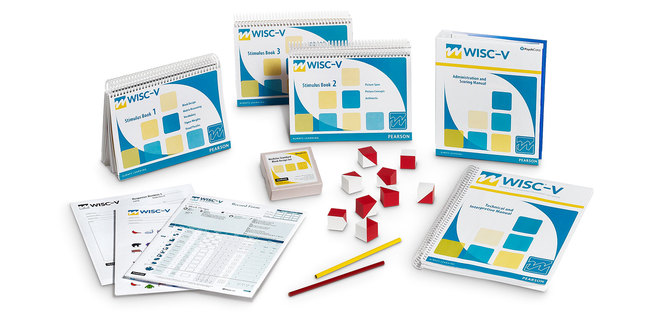
Wechsler Intelligence Scale for Children
The WISC has undergone multiple revisions—WISC-R, WISC-III, WISC-IV, and WISC-V—to enhance psychometric precision and to reflect modern theories of intelligence. The test provides a detailed profile of cognitive abilities across multiple domains rather than a single IQ score.
Structure and Subtests
The WISC is divided into Verbal Comprehension and Performance (Perceptual Reasoning) scales, each containing several subtests:
- Verbal Comprehension Index (VCI): Similarities, Vocabulary, Comprehension.
- Perceptual Reasoning Index (PRI): Block Design, Matrix Reasoning, Visual Puzzles.
- Working Memory Index (WMI): Digit Span, Arithmetic.
- Processing Speed Index (PSI): Coding, Symbol Search.
Each subtest measures specific cognitive processes, and together they yield Full-Scale IQ (FSIQ), representing overall intellectual functioning (Butcher, Mineka, & Hooley, 2014).
Administration and Scoring
The WISC is administered individually by a trained psychologist. Raw scores are converted to scaled scores, which are then combined to yield index scores and the FSIQ, with a mean of 100 and a standard deviation of 15. The test’s standardized procedures ensure high reliability and validity across diverse populations (Anastasi & Urbina, 2005).
Applications
The WISC serves multiple purposes in clinical and educational settings:
- Diagnosis of intellectual disability, learning disorders, and giftedness.
- Assessment of cognitive strengths and weaknesses, aiding individualized educational planning.
- Neuropsychological evaluation for brain injury, ADHD, and developmental disorders (Lezak, 1995).
- Research on cognitive development and psychopathology (Davison, Neal, & Kring, 2004).
Strengths and Limitations
The WISC’s strengths include its robust psychometric properties, wide normative base, and detailed profile of cognitive abilities. It allows clinicians to identify specific patterns of strengths and weaknesses, which are critical in planning interventions (Sarason & Sarason, 2005).
However, the test requires verbal comprehension and is language-dependent, which may disadvantage non-native speakers or children with speech impairments. Additionally, cultural differences can affect interpretation, as test norms are primarily derived from Western populations (Carson et al., 2007).
3. Vineland Social Maturity Scale (VSMS)
Developed by Edgar Doll (1935), the Vineland Social Maturity Scale (VSMS) was designed to measure social competence and adaptive behavior rather than cognitive ability. It recognizes that intellectual functioning alone does not determine how effectively an individual functions in everyday life (Barlow & Durand, 1999).
The VSMS thus complements intelligence tests by assessing how well an individual performs socially and practically in real-world settings—a key component in diagnosing intellectual disability (Kaplan, Sadock, & Grebb, 1994).
Structure and Domains
The VSMS evaluates social maturity across eight domains, reflecting different adaptive skills:
- Self-help General – Ability to perform daily activities.
- Self-help Eating – Independence in feeding.
- Self-help Dressing – Dressing skills.
- Self-direction – Responsibility and self-regulation.
- Occupation – Performance of age-appropriate tasks.
- Communication – Verbal and non-verbal communication skills.
- Locomotion – Mobility and physical independence.
- Socialization – Interaction with others.
Administration and Scoring
The VSMS can be administered through interviews with parents or caregivers and through direct observation. It is suitable for individuals from infancy to adulthood and can be adapted for various cultural contexts. Its simplicity and practical relevance make it ideal for use in community and clinical settings (Kapur, 1995).
Applications
The VSMS is extensively used to:
- Diagnose intellectual disability, where both IQ and SQ are considered together.
- Evaluate adaptive functioning for educational and vocational placement.
- Monitor progress in rehabilitation or training programs.
- Conduct research on social development and behavioral adaptation (Sundberg, Winebarger, & Taplin, 2002).
Strengths and Limitations
The VSMS’s major advantage lies in its focus on real-life behavior rather than academic or test-based performance. It provides a culturally flexible, behaviorally grounded assessment of social competence (Sarason & Sarason, 2005).
However, its reliance on caregiver reports may introduce subjectivity, and cultural norms about independence and socialization can affect scores. Despite these limitations, the VSMS remains an essential tool in comprehensive developmental assessment (Davison et al., 2004).
Conclusion
Assessment of intellectual disability requires a comprehensive approach that evaluates both cognitive and adaptive functioning. The Bhatia Battery (BKT), Wechsler Intelligence Scale for Children (WISC), and Vineland Social Maturity Scale (VSMS) each provide unique yet complementary perspectives on human intelligence and social adaptation.
While the BKT addresses cultural and linguistic challenges through its performance-based approach, the WISC offers a standardized, globally recognized measure of intellectual capacity. The VSMS, meanwhile, broadens the understanding of human functioning by emphasizing social and adaptive behavior—an equally critical dimension of intelligence.
Together, these tools form a robust foundation for diagnosing, understanding, and supporting individuals with intellectual disabilities. Their continued relevance underscores the enduring value of comprehensive, evidence-based assessment in promoting mental health, educational equity, and social inclusion.
References
Anastasi, A., & Urbina, S. (2005). Psychological Testing (7th Ed.). Pearson Education: India.
Barlow, D.H., & Durand, V.M. (1999). Abnormal Psychology (2nd Ed.). Pacific Grove: Brooks/Cole.
Butcher, J.N., Mineka, S., & Hooley, J.M. (2014). Abnormal Psychology (15th Ed.). Dorling Kindersley (India) Pvt. Ltd.
Carson, R.C., Butcher, J.N., Mineka, S., & Hooley, J.M. (2007). Abnormal Psychology (13th Ed.). Pearson Education India.
Davison, G.C., Neal, J.M., & Kring, A.M. (2004). Abnormal Psychology (9th Ed.). New York: Wiley.
Kapur, M. (1995). Mental Health of Indian Children. Sage Publications: New Delhi.
Kaplan, H.I., Sadock, B.J., & Grebb, J.A. (1994). Kaplan & Sadock’s Synopsis of Psychiatry: Behavioral Sciences, Clinical Psychiatry (7th Ed.). B.I. Waverly Pvt. Ltd: New Delhi.
Lezak, M.D. (1995). Neuropsychological Assessment. Oxford University Press: New York.
Sarason, I.G., & Sarason, B.R. (2005). Abnormal Psychology. N.D.: Dorling Kindersley.
Sundberg, N.D., Winebarger, A.A., & Taplin, J.R. (2002). Clinical Psychology: Evolving Theory, Practice, and Research. Prentice-Hall: Upper Saddle River, N.J.
Wolman, B.B. (1975). Handbook of Clinical Psychology. New York: McGraw Hill.
Niwlikar, B. A. (2025, October 21). 3 Important Intellectual Disability Assessment Techniques. Careershodh. https://www.careershodh.com/intellectual-disability-assessment-techniques/