
Introduction
Neuropsychological assessment integrates principles from psychology and neuroscience to evaluate cognitive, emotional, and behavioral functioning related to brain integrity. As Lezak (1995) notes, it serves as a vital bridge between brain structure and observable behavior, allowing clinicians to identify specific deficits, plan interventions, and monitor recovery or progression.
The growing prevalence of neurological disorders such as dementia, traumatic brain injury, epilepsy, and stroke has increased the demand for precise and culturally sensitive cognitive assessment tools. In India and other diverse populations, standardized Western tests often fail to account for cultural and linguistic differences (Kapur, 1995). Hence, the development and adaptation of tools like the Bhatia’s Battery of General Mental Ability (BGNB), Addenbrooke’s Cognitive Examination (ACE-III), and NIMHANS Neuropsychology Battery have been instrumental in clinical practice.
Read More: Mental Health Care
Theoretical Foundations of Neuropsychological Assessment
The conceptual underpinnings of neuropsychological assessment can be traced to early abnormal psychology, which sought to understand the relationship between brain lesions and behavioral disturbances (Davison, Neal, & Kring, 2004). From the psychometric tradition, as described by Anastasi and Urbina (2005), reliable measurement and standardized testing became the basis of modern assessment practice.
Lezak (1995) proposed that neuropsychological assessment is not merely a collection of tests but a comprehensive clinical process that interprets cognitive functioning within medical, psychological, and sociocultural contexts. Similarly, Wolman (1975) emphasized that such assessments must integrate data from clinical interviews, behavioral observations, and collateral reports for a holistic understanding.
Objectives of Neuropsychological Assessment
According to Barlow and Durand (1999), neuropsychological assessment aims to:
- Diagnose and localize brain dysfunction.
- Differentiate neurological from psychiatric conditions.
- Establish cognitive baselines before and after medical treatment.
- Guide rehabilitation and educational or occupational planning.
- Assess competency and functional independence.
These objectives make neuropsychological assessment an indispensable tool in both clinical and research settings (Sundberg, Winebarger, & Taplin, 2002).
Bender Gestalt Test (BGT)
Introduction
The Bender Visual–Motor Gestalt Test (BGT) was developed by Lauretta Bender in 1938 as a psychological assessment tool to evaluate visual–motor integration and perceptual organization.
The test requires individuals to copy geometric figures, and in advanced versions, to reproduce them from memory, thereby assessing both perceptual and memory functions.
It is based on principles of Gestalt Psychology, which emphasize the organization of visual stimuli into meaningful wholes.
The BGT is widely used in clinical, educational, neuropsychological, and forensic settings, and is suitable for individuals aged 3 years and above.
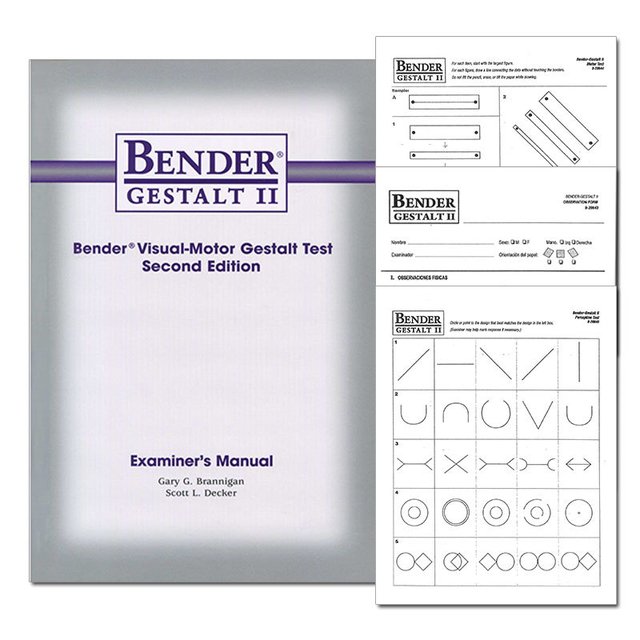
Bender Gestalt Test
Purpose of the Test
The test is used to assess visual–motor coordination, which reflects the integration between perception and motor execution.
It helps in evaluating the developmental maturity of children, particularly in relation to age-appropriate perceptual abilities.
It is used to screen for neurological impairments, including brain damage, traumatic brain injury, and other dysfunctions.
The test assists in identifying perceptual and motor deficits that may affect learning and daily functioning.
It also supports the diagnosis of learning disabilities and developmental delays in children.
Theoretical Basis
The test is based on Gestalt principles proposed by Max Wertheimer, which emphasize holistic perception.
According to this approach, individuals tend to organize visual elements into structured and meaningful patterns rather than isolated parts.
Any difficulty in reproducing these patterns may indicate underlying neurological or developmental issues.
Evolution of the Bender Gestalt Test
1. Original BGT (1938)
- The original BGT was developed by Lauretta Bender in 1938 as a tool to assess visual–motor functioning.
- The test consisted of nine geometric designs derived from Gestalt principles.
- The primary aim of the original test was to identify perceptual and neurological impairments.
- The scoring approach was qualitative and largely subjective, relying on clinical judgment.
2. Koppitz Developmental Scoring System (1964)
- The Koppitz system was developed by Elizabeth Koppitz to standardize the test for children.
- The test was specifically standardized for children aged 5 to 10 years.
- It introduced a developmental scoring system based on error patterns, making interpretation more objective.
- The system also included emotional indicators, which provided insights into the child’s psychological functioning.
3. Bender Gestalt II (BGT-II, 2003)
- The BGT-II was developed by Gary G. Brannigan and Robert L. Decker as an updated version of the test.
- The revised version expanded the age range to 4–85 years, making it applicable across the lifespan.
- It introduced a recall phase, allowing assessment of visual memory in addition to copying ability.
- Additional components such as the motor test and perception test were included to enhance diagnostic accuracy.
- The BGT-II provided standardized norms and improved psychometric properties, increasing its clinical utility.
Test Administration
A. Materials Required
- The test requires standard stimulus cards containing geometric designs to be copied by the participant.
- White paper is provided for drawing responses during the test.
- A pencil with an eraser is used to allow corrections during drawing.
- An observation form is used to record behavioral responses and qualitative observations.
- A stopwatch is used during the recall phase to monitor time.
- A scoring manual is required for accurate interpretation of responses.
B. Procedure
Copy Phase
In the copy phase, the participant is asked to reproduce geometric figures exactly as shown. This phase assesses visual–motor integration, perceptual accuracy, and motor coordination.Recall Phase (BGT-II)
In the recall phase, the participant is asked to draw the figures from memory after a delay. This phase evaluates visual memory, encoding, and retrieval processes.Motor Test
The motor test includes simple tasks designed to assess fine motor coordination and control. It helps in identifying motor deficits or neurological soft signs.Perception Test
The perception test involves recognition or matching tasks without drawing. This phase assesses visual perception independent of motor ability.
Scoring Systems
- 1. Global Scoring System
- The global scoring system uses a five-point scale ranging from 0 to 4 to evaluate each design.
- A score of 4 indicates a nearly perfect reproduction, while a score of 0 indicates no resemblance or scribbling.
- Higher scores reflect better visual–motor performance and perceptual accuracy.
2. Lacks Scoring System
- The Lacks system focuses on identifying the presence of specific error types rather than their frequency.
- Each error category is scored only once, even if it appears multiple times.
- Corrections and erasures are considered acceptable and are not penalized.
- The total score ranges from 0 to 12, with higher scores indicating greater dysfunction.
Error Categories
Group 1: Structural Errors
- Rotation refers to drawings that are rotated more than 30 degrees from the original orientation.
- Overlapping difficulty occurs when the participant fails to correctly reproduce overlapping elements.
- Simplification involves reducing complex figures into overly simple forms.
Group 2: Organizational Errors
- Fragmentation occurs when a figure is broken into disconnected parts.
- Retrogression refers to drawing immature or developmentally younger forms.
- Perseveration involves repetition of elements beyond what is required.
Group 3: Spatial Errors
- Collision occurs when lines or figures incorrectly intersect or overlap.
- Impotence refers to faint or incomplete drawings, suggesting lack of effort or control.
- Closure difficulty involves failure to properly complete shapes.
Group 4: Motor Errors
- Motor incoordination is reflected in shaky or poorly controlled lines.
- Angulation refers to incorrect angles or distortions in direction.
- Cohesion errors occur when the figure lacks integration into a coherent whole.
Interpretation of Scores
- A score of 0–3 errors suggests no evidence of neurological impairment.
- A score of 4 errors is considered borderline and requires cautious interpretation.
- A score of 5–6 errors indicates mild evidence of impairment.
- A score of 7–8 errors suggests strong evidence of neurological dysfunction.
- A score of 9 or more errors indicates severe impairment.
Psychometric Properties
- The test demonstrates moderate reliability, which has improved in the BGT-II due to better standardization.
- It shows good concurrent validity with other visual–motor and neuropsychological measures.
- The BGT-II provides strong normative data across a wide age range.
- The test has adequate sensitivity for detecting neurological and developmental impairments, though it is less effective for psychiatric conditions.
Applications of the Test
1. Neuropsychological Assessment
The test is used to screen for brain injuries, dementia, stroke, and other neurological conditions.
It helps in identifying deficits in visual–motor integration associated with brain dysfunction.
2. Developmental Assessment
The test helps in identifying learning disabilities and developmental delays in children.
It provides insight into the level of visual–motor maturity relative to age norms.
It assists in planning interventions and educational strategies based on the child’s performance.
3. Forensic Psychology
The test is used to assess cognitive functioning in legal contexts.
It may help in identifying neurological impairment or malingering in forensic evaluations.
-Strengths
- The test has a wide age range, especially in the BGT-II (4–85 years), making it highly versatile.
- It is quick, simple, and cost-effective to administer in various settings.
- The availability of multiple scoring systems enhances its interpretative value.
- It is useful as a screening tool for neurological and developmental disorders.
Limitations
- The test shows moderate reliability, especially in older versions and subjective scoring systems.
- Performance may be influenced by cultural background, education, and familiarity with drawing tasks.
- The test has limited scope, as it does not assess language, reasoning, or higher cognitive functions.
- Interpretation may involve subjectivity, particularly in qualitative analysis.
- Results can be affected by anxiety, fatigue, motor difficulties, or lack of effort.
Conclusion
The Bender Gestalt Test is a valuable tool for assessing visual–motor integration and neurological functioning. While modern versions like BGT-II have improved its reliability and scope, it is best used as a screening and supplementary assessment tool, rather than a standalone diagnostic measure.
2. Addenbrooke’s Cognitive Examination – III (ACE-III)
The ACE-III is a comprehensive cognitive screening tool designed to detect early cognitive impairment and differentiate between various types of dementia (Hsieh et al., 2013, as discussed in Lezak, 1995). It builds upon earlier versions (ACE and ACE-R) and assesses five domains:
- Attention and orientation
- Memory
- Verbal fluency
- Language
- Visuospatial skills

ACE 3
Administration and Scoring
The ACE-III takes approximately 15–20 minutes to administer, with a total score out of 100. Cutoff scores of 82–88 typically indicate cognitive impairment. Its items include tasks such as recalling an address, drawing intersecting pentagons, naming pictures, and verbal fluency exercises.
Diagnostic Relevance
According to Nolen-Hoeksema (2004) and Barlow and Durand (1999), one of the ACE-III’s major strengths lies in its diagnostic sensitivity. It helps differentiate Alzheimer’s disease (characterized by memory and language deficits) from frontotemporal dementia (marked by language and executive dysfunction). Compared to the Mini-Mental State Examination (MMSE), the ACE-III offers greater sensitivity for early and mild cognitive decline (Lezak, 1995).
Cross-Cultural Adaptations
The ACE-III has been translated and validated in multiple languages, including Hindi, Tamil, and Bengali, ensuring cross-cultural applicability. Kapur (1995) emphasizes that culturally adapted versions of such tools are critical in multilingual societies like India to avoid diagnostic errors stemming from language bias.
3. NIMHANS Neuropsychology Battery
Developed at the National Institute of Mental Health and Neurosciences (NIMHANS), Bangalore, under the guidance of Professor M. Kapur in the 1990s, the NIMHANS Neuropsychology Battery represents India’s most comprehensive indigenous cognitive assessment tool (Kapur, 1995). It was designed to assess diverse neurological and psychiatric populations within Indian socio-cultural contexts.

NIMHANS Neuropsychological Test Battery
Structure of the Battery
The NIMHANS Battery includes tests across major cognitive domains:
- Attention and processing speed – Digit Span, Colour Trails, and Coding tests.
- Memory – Verbal and visual learning, immediate and delayed recall.
- Language – Comprehension, fluency, and naming tasks.
- Visuospatial ability – Block design, figure copying, and constructional praxis.
- Executive function – Tower of London, verbal fluency, and card sorting tasks.
- Motor skills and psychomotor speed – Finger tapping, pegboard tests.
Lezak (1995) underscores that comprehensive batteries like this allow fine-grained analysis of cognitive strengths and deficits, aiding localization and functional assessment.
Normative and Cultural Considerations
The NIMHANS Battery was standardized on Indian samples, accounting for variations in age, education, and language. This cultural specificity ensures ecological validity, enhancing its diagnostic precision (Kapur, 1995). Such localization contrasts with imported tests that often overpathologize culturally normative differences (Sarason & Sarason, 2005).
Clinical Applications
The battery is used in diverse clinical populations:
- Epilepsy – assessing lateralization of dysfunction before surgery.
- Traumatic brain injury – evaluating post-concussive cognitive deficits.
- Dementia – mapping cognitive decline across domains.
- Schizophrenia and mood disorders – understanding cognitive impairments secondary to psychiatric conditions.
According to Sundberg et al. (2002), the integration of test results with behavioral observations enhances treatment planning, rehabilitation, and caregiver education.
Strengths and Limitations
The NIMHANS Battery’s primary advantage lies in its cultural relevance and breadth. However, it is time-intensive and requires specialized training for administration and interpretation. Moreover, as Barlow and Durand (1999) point out, complex batteries may not always be practical in primary care or community settings, where shorter tools like ACE-III are more feasible.
Psychometric and Ethical Considerations
According to Anastasi and Urbina (2005), test reliability, validity, and standardization form the core of psychometric soundness. Neuropsychological tests must demonstrate internal consistency and sensitivity to change. Equally vital are ethical concerns related to informed consent, confidentiality, and test adaptation.
Kellerman and Burry (1981) stress the importance of transparent reporting and culturally sensitive interpretation. Misuse of results can lead to stigmatization, especially in populations with limited access to education or healthcare (Taylor, 2006).
Role of Clinical Psychologists
Clinical psychologists play a central role in neuropsychological assessment—selecting appropriate tools, administering tests, interpreting results, and integrating findings with behavioral and medical data (Sundberg et al., 2002). Their expertise extends to psychoeducation, rehabilitation planning, and liaison with neurologists, psychiatrists, and occupational therapists.
Health psychologists (Brannon & Feist, 2007; Taylor, 2006) contribute by promoting cognitive health, adherence to treatment, and psychosocial adaptation in patients with chronic neurological conditions.
Neuropsychological Assessment in the Indian Context
Kapur (1995) and Lezak (1995) emphasize that culturally adapted assessment is indispensable for diagnostic accuracy. In India, linguistic diversity, educational disparities, and socio-economic variations necessitate indigenous norms and translation of global tests. The NIMHANS Battery exemplifies culturally embedded assessment practice, balancing global psychometric rigor with local contextual relevance.
Furthermore, community-based screening programs employing tools like ACE-III (in regional languages) can facilitate early dementia detection and intervention in rural populations, aligning with public health goals.
Integration with Modern Technology
Recent developments in computerized neuropsychological testing have improved standardization and scoring accuracy (Sarason & Sarason, 2005). Digital platforms now replicate traditional tasks such as memory recall and reaction-time tests while recording precise performance metrics. However, as Wolman (1975) cautions, these should complement—not replace—clinician judgment and qualitative analysis.
In the Indian context, hybrid models combining computerized tests with traditional batteries are emerging, offering scalable yet context-sensitive solutions.
Clinical Interpretation and Reporting
Effective interpretation requires synthesizing test results into coherent clinical profiles. According to Lezak (1995), patterns of deficits across domains often reveal the locus and nature of brain dysfunction. For example:
- Frontal lobe damage = impaired executive function and working memory.
- Temporal lobe dysfunction = deficits in episodic memory and language.
- Parietal lobe involvement = visuospatial disorganization.
Kellerman and Burry (1981) recommend that reports should include behavioral observations, test limitations, and clear, actionable recommendations for patients and caregivers.
Future Directions
The future of neuropsychological assessment lies in integrated multimodal approaches combining psychometric testing, neuroimaging, and biomarkers. Artificial intelligence and machine learning models are being explored to predict cognitive decline trajectories. Nonetheless, as Lezak (1995) and Sundberg et al. (2002) remind, clinical insight, empathy, and contextual understanding remain irreplaceable.
Conclusion
Neuropsychological assessment represents a vital interface between mind, brain, and behavior. The BGNB, ACE-III, and NIMHANS Neuropsychology Battery collectively illustrate the evolution of cognitive testing—from culture-fair intelligence measures to sophisticated domain-specific assessments. Grounded in rigorous psychometric theory and enriched by cultural adaptation, these tools provide clinicians with invaluable insights into cognitive functioning.
As populations age and neurological disorders rise, the demand for accurate, ethical, and culturally valid neuropsychological assessment continues to grow. Guided by the foundational principles articulated by Lezak (1995), Kapur (1995), and Sarason and Sarason (2005), neuropsychological assessment will remain a cornerstone of clinical psychology—integrating science with humanity to enhance understanding, care, and quality of life for individuals with cognitive impairment.
References
Alloy, L. B., Riskind, J. H., & Manos, M. J. (2005). Abnormal Psychology: Current perspectives (9th ed.). Tata McGraw-Hill.
Anastasi, A., & Urbina, S. (2005). Psychological Testing (7th ed.). Pearson Education.
Barlow, D. H., & Durand, V. M. (1999). Abnormal Psychology (2nd ed.). Books/Cole.
Brannon, L., & Feist, J. (2007). Introduction to Health Psychology. Thomson Wadsworth.
Carson, R. C., Butcher, J. N., Mineka, S., & Hooley, J. M. (2007). Abnormal Psychology (13th ed.). Pearson Education India.
Davison, G. C., Neal, J. M., & Kring, A. M. (2004). Abnormal Psychology (9th ed.). Wiley.
Kaplan, H. I., Sadock, B. J., & Grebb, J. A. (1994). Kaplan and Sadock’s Synopsis of Psychiatry (7th ed.). B.I. Waverly Pvt. Ltd.
Kapur, M. (1995). Mental Health of Indian Children. Sage Publications.
Kellerman, H., & Burry, A. (1981). Handbook of Diagnostic Testing: Personality Analysis and Report Writing. Grune & Stratton.
Lezak, M. D. (1995). Neuropsychological Assessment. Oxford University Press.
Nolen-Hoeksema, S. (2004). Abnormal Psychology (3rd ed.). McGraw Hill.
Rychlak, F. (1973). Introduction to Personality and Psychopathology. Houghton Muffin.
Sarason, I. G., & Sarason, B. R. (2005). Abnormal Psychology. Dorling Kindersley.
Sundberg, N. D., Winebarger, A. A., & Taplin, J. R. (2002). Clinical Psychology: Evolving Theory, Practice and Research. Prentice-Hall.
Taylor, S. (2006). Health Psychology. Tata McGraw-Hill.
Wolman, B. B. (1975). Handbook of Clinical Psychology. McGraw Hill.
Niwlikar, B. A. (2025, October 27). 3 Important Neuropsychological Assessment. Careershodh. https://www.careershodh.com/3-important-neuropsychological-assessment/