
Deductive and Empirical Strategies
Psychometric testing has undergone substantial evolution, with strategies classified broadly into deductive and empirical approaches. Each method involves unique processes, theoretical foundations, and practical applications. Prominent examples like the Woodworth Personal Data Sheet (WPDS) and the Edwards Personal Preference Schedule (EPPS) illustrate deductive strategies, while the 16 Personality Factor Questionnaire (16PF) and Minnesota Multiphasic Personality Inventory (MMPI) demonstrate empirical approaches.
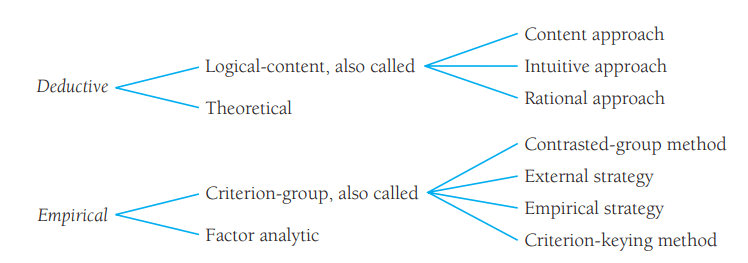
deductive and empirical strategies
Read More- Personality
Deductive Strategies
Deductive strategies rely on logical reasoning or theoretical frameworks to construct test items. These methods assume a direct link between test items and the personality traits or behaviors being assessed. Deductive strategies include the logical-content approach and the theoretical approach.
1. Logical-Content Strategy
The logical-content strategy focuses on crafting items based on face validity—how directly they appear to measure a specific trait or behavior. This approach assumes that respondents will interpret questions as intended and provide truthful answers. Early personality tests predominantly relied on this strategy due to its simplicity.
Woodworth Personal Data Sheet (WPDS)
The Woodworth Personal Data Sheet (WPDS) is a classic example of the logical-content strategy. Developed during World War I, it was designed to identify soldiers at risk for psychological breakdowns. Items were straightforward, such as “Do you sleep well?” and “Do you often feel sad?” These items aimed to measure symptoms of anxiety, depression, and other emotional issues.

WPDS
The WPDS was essentially a screening tool, relying on the assumption that individuals’ self-reported answers accurately reflected their psychological state. It marked a significant milestone in structured personality testing, being the first of its kind to use a questionnaire format to assess emotional stability.
Read More- Woodworth Personal Data Sheet
Strengths of the Logical-Content Strategy
- Simplicity- The logical-content method is straightforward to design and administer. Developers use intuitive reasoning to generate test items relevant to the target construct (Kaplan & Saccuzzo, 2018).
- Face Validity- The clear connection between items and constructs enhances the respondent’s understanding and engagement (Ben-Porath & Butcher, 1991).
- Pioneering Impact- The WPDS demonstrated that standardized questionnaires could effectively assess psychological conditions, paving the way for modern tests.
Limitations of the Logical-Content Strategy
- Response Bias- Items are susceptible to social desirability and faking, as respondents can easily identify the socially acceptable answer (Kaplan & Saccuzzo, 2018).
- Reliance on Self-Insight- The approach assumes that individuals have accurate self-awareness and report their traits honestly, which may not always be the case (Waller, 1999).
- Lack of Statistical Rigor- Logical-content tests may lack empirical validation, leading to potential issues with reliability and validity (Butcher, 2000).
2. Theoretical Strategy
The theoretical strategy begins with a psychological theory that defines the constructs to be measured. Test developers craft items consistent with the theoretical framework, ensuring that each item reflects the theory’s constructs. Unlike the logical-content strategy, this approach uses statistical techniques to refine scales and improve measurement precision.
Edwards Personal Preference Schedule (EPPS)
The Edwards Personal Preference Schedule (EPPS) exemplifies the theoretical strategy. Based on Henry Murray’s theory of personality needs, the EPPS measures 15 different psychological needs, including achievement, affiliation, and order. Items were carefully designed to reflect these needs, and forced-choice formats were used to reduce response bias. For instance, respondents were required to choose between two statements, both of which had equal social desirability, such as:
- “I prefer working with others.”
- “I prefer solving problems independently.”
This design aligns closely with Murray’s theory and avoids the pitfalls of direct self-reporting.
Read More- Edwards Personal Preference Schedule
Strengths of the Theoretical Strategy
- Strong Theoretical Basis- The EPPS demonstrates how a well-defined theoretical foundation can guide test construction and interpretation (Wiggins, 1973).
- Reduction of Response Bias- Techniques like forced-choice formats reduce socially desirable responses, enhancing the test’s accuracy (Kaplan & Saccuzzo, 2018).
- Internal Consistency- Items are designed to measure specific constructs, resulting in homogeneous and reliable scales (Waller, 1999).
Limitations of the Theoretical Strategy
- Dependence on Theory- The quality of the test is contingent on the validity and completeness of the underlying theory (Ben-Porath & Butcher, 1991).
- Limited Generalizability- A narrowly focused theory may overlook important dimensions of personality, reducing the test’s applicability to diverse populations (Waller, 1999).
- Complex Scoring- The forced-choice format used in the EPPS complicates scoring and interpretation compared to simpler formats (Kaplan & Saccuzzo, 2018).
Empirical Strategies
Empirical strategies prioritize data-driven methods, using statistical analyses to select items that reliably measure traits or distinguish between groups. These approaches are less reliant on theoretical assumptions and emphasize item performance based on empirical evidence.
1. Criterion-Group Strategy
The criterion-group strategy involves selecting items that differentiate between a criterion group (e.g., individuals with a specific psychological condition) and a control group. This approach focuses on empirical discrimination rather than logical content.
Minnesota Multiphasic Personality Inventory (MMPI)
The Minnesota Multiphasic Personality Inventory (MMPI) is a classic example of the criterion-group strategy. Developed in the 1940s, the MMPI aimed to differentiate individuals with psychological disorders from those without. Items were chosen based on their ability to discriminate between these groups. For example, individuals with depression might answer “False” to the statement, “I enjoy life,” significantly more often than controls.

MMPI Profile Sheet
The MMPI also included validity scales to detect inconsistent or exaggerated responses, addressing the issue of response bias.
Read More- Minnesota Multiphasic Personality Inventory
Strengths of the Criterion-Group Strategy
- Empirical Validation- Items are selected based on their statistical ability to differentiate between groups, ensuring high reliability and validity (Kaplan & Saccuzzo, 2018).
- Cross-Validation- The MMPI’s scales were tested on independent samples, demonstrating robustness across populations (Waller, 1999).
- Comprehensive Scope- The MMPI assesses multiple dimensions of personality and psychopathology, making it a versatile diagnostic tool (Butcher, 2000).
Limitations of the Criterion-Group Strategy
- Arbitrary Content- Items selected for their discriminative power may lack face validity, complicating interpretation (Wiggins, 1973).
- Time and Effort Intensive- Identifying criterion groups and validating scales require substantial resources (Kaplan & Saccuzzo, 2018).
- Context Dependence- The utility of the test depends on the continued relevance of the original criterion groups, which may evolve over time (Butcher, 2000).
2. Factor-Analytic Strategy
The factor-analytic strategy uses statistical techniques to identify clusters of related items, or factors, that represent underlying traits. This approach is particularly useful for identifying the structure of personality.
16 Personality Factor Questionnaire (16PF)
The 16 Personality Factor Questionnaire (16PF), developed by Raymond Cattell, is a prominent example of the factor-analytic strategy. Using factor analysis, Cattell identified 16 primary personality dimensions, such as warmth, emotional stability, and dominance. Items for the 16PF were selected based on their correlations with these factors, ensuring that each scale measures a distinct trait.
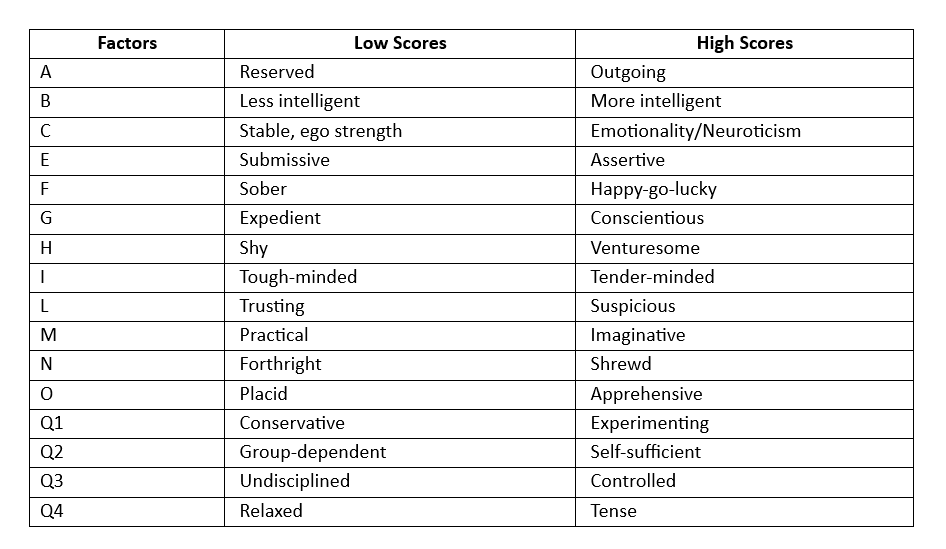
Cattell’s Theory
Read More- 16 Personality Factors
Strengths of the Factor-Analytic Strategy
- Comprehensive Insights- Factor analysis reveals underlying dimensions of personality, providing a detailed and nuanced assessment (Kaplan & Saccuzzo, 2018).
- Statistical Rigor- The method ensures that scales are empirically derived and internally consistent (Waller, 1999).
- Applicability- The 16PF demonstrates how factor analysis can produce a robust and versatile personality test (Butcher, 2000).
Limitations of the Factor-Analytic Strategy
- Complexity- The statistical methods involved require expertise and computational resources, making the process inaccessible to some practitioners (Wiggins, 1973).
- Interpretation Challenges- Factors identified through analysis may not align with existing theories, complicating their interpretation (Waller, 1999).
- Overreliance on Data- The strategy focuses exclusively on statistical relationships, potentially overlooking theoretical and practical considerations (Kaplan & Saccuzzo, 2018).
Deductive vs Empirical Approach
Deductive strategies rely on theoretical or logical reasoning to guide the development of test items. These approaches assume a direct and transparent relationship between the items and the psychological traits being measured. Test designers either deduce items based on their understanding of the construct (logical-content approach) or create items grounded in a specific psychological theory (theoretical approach).
For instance, in the logical-content approach, items are created to measure specific traits or behaviors based on their obvious relevance. A classic example is the Woodworth Personal Data Sheet (WPDS), which aimed to screen for emotional instability by including straightforward items like “Do you sleep well?” The assumption is that responses accurately reflect the underlying trait.
In contrast, the theoretical approach begins with a formal psychological theory to structure test construction. Items are developed to align closely with theoretical constructs, as seen in the Edwards Personal Preference Schedule (EPPS). Based on Henry Murray’s theory of needs, the EPPS includes items that represent specific psychological needs, ensuring alignment with the theoretical framework.
Empirical strategies prioritize data-driven approaches, using statistical analysis to identify items that empirically distinguish between groups or reveal underlying personality traits. These methods do not require a direct theoretical connection between items and constructs, focusing instead on how items perform in practice.
One approach within this strategy is the criterion-group method, which identifies items that differentiate a criterion group (e.g., individuals with a specific disorder) from a control group. For example, the Minnesota Multiphasic Personality Inventory (MMPI) uses items that distinguish individuals with psychological conditions, such as depression or paranoia, from a general population. These items are validated through statistical analysis and cross-validation, ensuring high reliability and discriminative power.
Another empirical approach is the factor-analytic strategy, which uses statistical techniques to identify clusters of related items that represent distinct personality dimensions. The 16 Personality Factor Questionnaire (16PF), for instance, was developed by analyzing correlations among items to identify 16 primary personality factors. This method ensures that scales are empirically derived and represent unique constructs.
Conclusion
Deductive strategies focus on logical or theoretical item generation, prioritizing simplicity and theoretical alignment but often lacking empirical rigor. Conversely, empirical strategies emphasize statistical validation and discriminative accuracy but require significant resources and expertise for development.
Reference
Ben-Porath, Y. S., & Butcher, J. N. (1991). The Minnesota Multiphasic Personality Inventory (MMPI) in psychological research and practice. Washington, DC: American Psychological Association.
Butcher, J. N. (2000). Personality assessment in psychological practice. New York: Guilford Press.
Kaplan, R. M., & Saccuzzo, D. P. (2018). Psychological testing: Principles, applications, and issues (9th ed.). Belmont, CA: Cengage Learning.
Waller, N. G. (1999). Evaluating the reliability and validity of personality tests. Journal of Personality Assessment, 73(1), 32-49.
Wiggins, J. S. (1973). Personality and prediction: Principles of personality assessment. Reading, MA: Addison-Wesley.
Niwlikar, B. A. (2026, September 13). Deductive and Empirical Strategies to Test Construction and 2 Important Examples in Each. Careershodh. https://www.careershodh.com/deductive-and-empirical-strategies/